Strength training on a GLP-1: simple home and gym plans
Protein provides the bricks, and strength training sends the signal to keep muscle. Here are practical 2-day home and 3-day gym resistance plans built for lower energy and smaller appetites on Ozempic, Wegovy or Zepbound.
By the Lean But Strong editorial team · Updated November 25, 2026 · 8 min read · Not medical advice
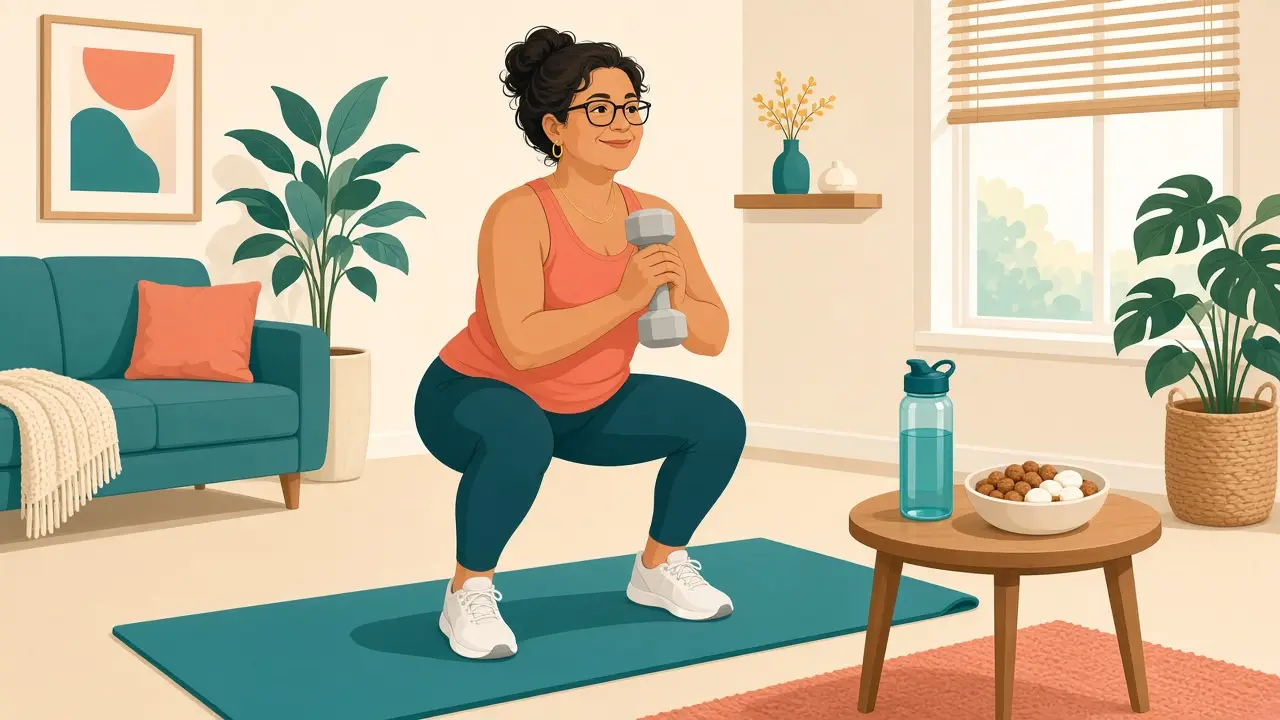
When you are losing weight on a GLP-1 medicine, your body is looking for energy. Daily walking helps cardiovascular fitness, mood and digestion — especially if you deal with constipation — but walking does not give your upper body or major leg muscles a strong enough reason to stick around.
Both the US Physical Activity Guidelines and the 2025 ACLM/ASN/OMA/TOS joint nutrition advisory recommend pairing weight-loss therapy with structured resistance training at least 2 to 3 days per week. You do not need marathon 90-minute gym sessions. You need short, repeatable sessions focused on big movement patterns.
Why walking alone is not enough
Muscle tissue is expensive for your body to maintain when calories are low. Mechanical tension — pushing, pulling, squatting and hinging against resistance — sends a chemical signal that tells your body to spare skeletal muscle and pull energy from fat stores instead. Without that signal, a larger share of weight loss tends to come from lean mass.
Four rules for training on lower calories
- Keep sessions to 25–40 minutes. Long, exhausting workouts spike fatigue when you are eating less. Two or three crisp sets per exercise beat six sloppy ones.
- Work close to effort, not exhaustion. Stop each set when you could still do about 2 more clean reps (roughly a 7–8 out of 10 effort).
- Train full-body movements. Every session should touch a squat/lunge pattern, a hip hinge, a push, a pull and a loaded carry or core brace.
- Fuel and hydrate around training. Pair lifting with 1.2–1.6 g/kg/day of protein and steady fluids. On warm days or low-food days, see our fluids & electrolytes guide.
Plan A: 2-day home workout (chair, bands or dumbbells)
Do this on two non-consecutive days (for example, Tuesday and Friday). Rest 60 to 90 seconds between sets. Print this page or save it on your phone.
| Movement pattern | Exercise (pick your level) | Sets × Reps |
|---|---|---|
| Squat | Chair sit-to-stand → bodyweight squat → dumbbell goblet squat | 3 × 8–12 |
| Push | Wall push-up → kitchen-counter incline push-up → floor push-up | 3 × 8–12 |
| Pull | Resistance-band row → single-arm dumbbell row | 3 × 10–12 each |
| Hinge / Glutes | Glute bridge → single-leg bridge or dumbbell Romanian deadlift | 3 × 10–12 |
| Carry / Core | Carry two loaded grocery bags or dumbbells upright | 2 × 30–45 sec |
Plan B: 3-day gym machine & dumbbell plan
Machines are underrated for GLP-1 users: they stabilize your body, lower injury risk if you are new to lifting, and make weight jumps easy to track. Rotate Session A and Session B across 3 days a week (e.g., Mon / Wed / Fri: A, B, A, then B, A, B).
Session A
- Leg press or goblet squat: 3 sets × 8–12 reps
- Chest press machine or dumbbell bench press: 3 sets × 8–12 reps
- Seated cable row or chest-supported row machine: 3 sets × 10–12 reps
- Seated hamstring curl: 2 sets × 10–12 reps
- Pallof press or plank: 2 sets × 30 seconds
Session B
- Dumbbell Romanian deadlift or back extension: 3 sets × 8–12 reps
- Overhead dumbbell or machine shoulder press: 3 sets × 8–12 reps
- Lat pulldown (neutral or wide grip): 3 sets × 10–12 reps
- Step-ups or split squats (hold support if needed): 2 sets × 8–10 per leg
- Farmer's walk (dumbbells at sides): 2 sets × 40 yards
How to progress without burning out
Use double progression: stay at the same weight until you can cleanly hit the top of the rep range (for instance, 12 reps) on all 3 sets. Next week, nudge the weight up by 2.5 to 5 lb and drop back to 8 reps. That gentle climb is enough to preserve — and for beginners, even build — muscle while fat comes off.
Some lifters also pair resistance training with 3 to 5 g/day of plain creatine monohydrate; read what the evidence shows in our creatine guide and compare third-party-tested powders in our creatine ranking. To verify that your plan is working, track a baseline and 3-to-4-month follow-up DEXA scan.
Not medical advice. If you have joint pain, heart conditions, dizziness, or have been inactive for a long time, check with your clinician before starting a new exercise program.
Frequently asked questions
How many days a week do I need to lift on a GLP-1?
Most adults see solid muscle-retention benefits from 2 to 3 full-body resistance sessions per week, which aligns with the US Physical Activity Guidelines minimum of muscle-strengthening work on at least 2 days a week.
Should I do heavy weights or light weights with high reps?
Both build and preserve muscle if the last 2 to 3 reps of each set feel genuinely challenging. Pick a weight or band tension where 8 to 12 slow, controlled reps leave you with about 2 reps left in the tank.
What if I feel too tired or nauseous to work out?
Do not force intense sessions on days when nausea, vomiting or poor hydration hits. Shorten the session to 15 minutes, walk gently, prioritize fluids and electrolytes, and talk to your clinician if fatigue persists.
Sources
- US Department of Health and Human Services. Physical Activity Guidelines for Americans, 2nd edition.
- Nutritional priorities to support GLP-1 therapy for obesity: joint advisory of ACLM, ASN, OMA and TOS (2025).
- Morton RW et al. A systematic review, meta-analysis and meta-regression of the effect of protein supplementation on resistance training-induced gains in muscle mass and strength in healthy adults. Br J Sports Med 2018.
- Neeland IJ et al. Changes in lean body mass with GLP-1-based therapies and mitigation strategies. Diabetes Obes Metab 2024.